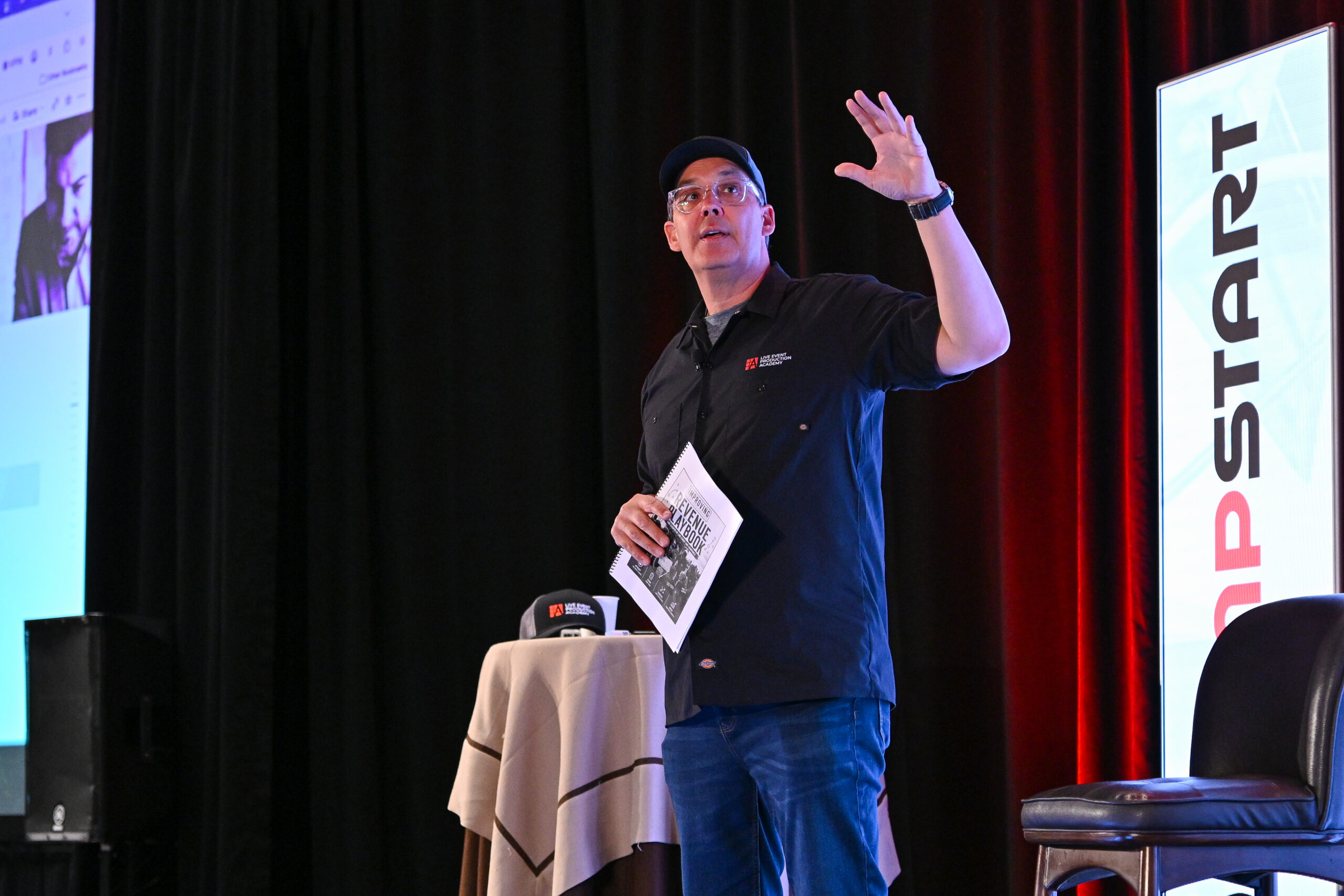
Most live production company owners treat new business as a single event: send the proposal, win the job or lose it, move on to the next name on the list. Karl Becker led two sales sessions at Jumpstart Las Vegas this July, and both were built around taking that idea apart. His argument was that almost nobody arrives ready to buy the moment you meet them, and the reason so many pipelines feel thin isn’t a shortage of prospects, it’s that most owners are only paying attention to the very end of a process that actually runs through six distinct stages.
The funnel is longer than the moment you start tracking it
The framework laid out across both sessions started well before any prospect has heard of your company and ran all the way through what happens after you win the work. A lead begins outside the funnel entirely, someone who doesn’t yet know you exist or that you’d be relevant to them. From there it moves into relationship building, the stretch where most of the real work actually happens and where most owners stop paying close attention because nothing measurable seems to be occurring. Only after that comes a proposal, then a close, and then the stage owners tend to treat as the finish line but that Becker positioned as just another phase: retention and growth with a client who’s already said yes once.
The point of laying it out this way wasn’t to add process for its own sake. It was to make the case that relationships take time on a predictable timeline, and that a company chasing revenue by skipping straight to proposals is trying to compress a stage that can’t be compressed. If your pipeline only has two states, “not yet a client” and “client,” you have no way to see where a relationship is actually stuck, and no way to know what kind of contact would move it forward. A prospect six months into relationship building needs something completely different from one who’s sitting on an unanswered proposal, and treating them the same is why so much outreach falls flat.
The people who can open a door aren’t the people you’d think to call
The session’s most practical exercise asked owners to map out who they already know who’s adjacent to their ideal client, not competitors, and not even people who work in the events industry at all. The logic is that your next best client is usually one or two connections away from someone already in your network: a vendor you’ve worked with on an unrelated project, someone from a board you sit on, a friend whose spouse works in association management. These are people who aren’t thinking about you as a source of referrals because nobody has ever framed the ask for them clearly.
The specific move Becker walked the room through was replacing the vague version of that ask, something like “let me know if you hear of anyone who needs production,” with something narrow enough that the other person can actually act on it. Naming the exact type of organization, the exact type of event, and the exact person you’d want an introduction to turns an abstract favor into something someone can do in one email. Low-friction asks get answered. Open-ended ones get forgotten within the hour.
Stop checking in. Start showing up with something.
One of the sharper points from the session addressed the stalled lead, the prospect who went quiet somewhere in the middle of the funnel and hasn’t responded in weeks. The instinct most owners have is to send a status-check email, something along the lines of “just following up, wanted to see where this stands.” Becker’s argument was that this kind of message asks the recipient to do work, formulating an answer, managing an awkward silence, for absolutely nothing in return, which is exactly why it so often goes unanswered.
The alternative is to reactivate the relationship with something of value instead of a question: an article relevant to their event, a resource that solves a problem they mentioned earlier, a photo from a past project that reminds them what working together actually looked like. None of it asks anything of the recipient. It just puts you back in front of them with a reason to respond that has nothing to do with your need for an answer.
A connection that had nothing to do with events, until it did
The session included a real example that made the warm-introduction point concrete. A networking connection, made with no events angle at all at the time, ended up leading directly to new client relationships down the line. The person on the other end of that original conversation wasn’t a prospect and wasn’t trying to be helpful in any sales sense. The relationship existed for its own reasons, and the business came later, once there was a reason for it to.
That’s the piece most owners miss when they think about where new business comes from. The network that eventually produces a client rarely looks like a sales funnel while it’s being built. It looks like an ordinary relationship that happened to exist when the right moment arrived. The owners who get the most out of that dynamic aren’t the ones with the biggest networks. They’re the ones who kept in touch with people for reasons that had nothing to do with selling them anything, and who knew how to ask when the moment came.