Most conversations about AI start in the wrong place.
Which platform should we use? Which model is better? Which tool should we buy? What can we automate?
Those questions matter eventually, but they are not usually the reason companies struggle to get useful results from AI. In his AI workshops at Jumpstart Vegas, Mark Wells argued that the bigger problem comes much earlier. Most businesses have not captured enough of what they already know for AI to do much with it.
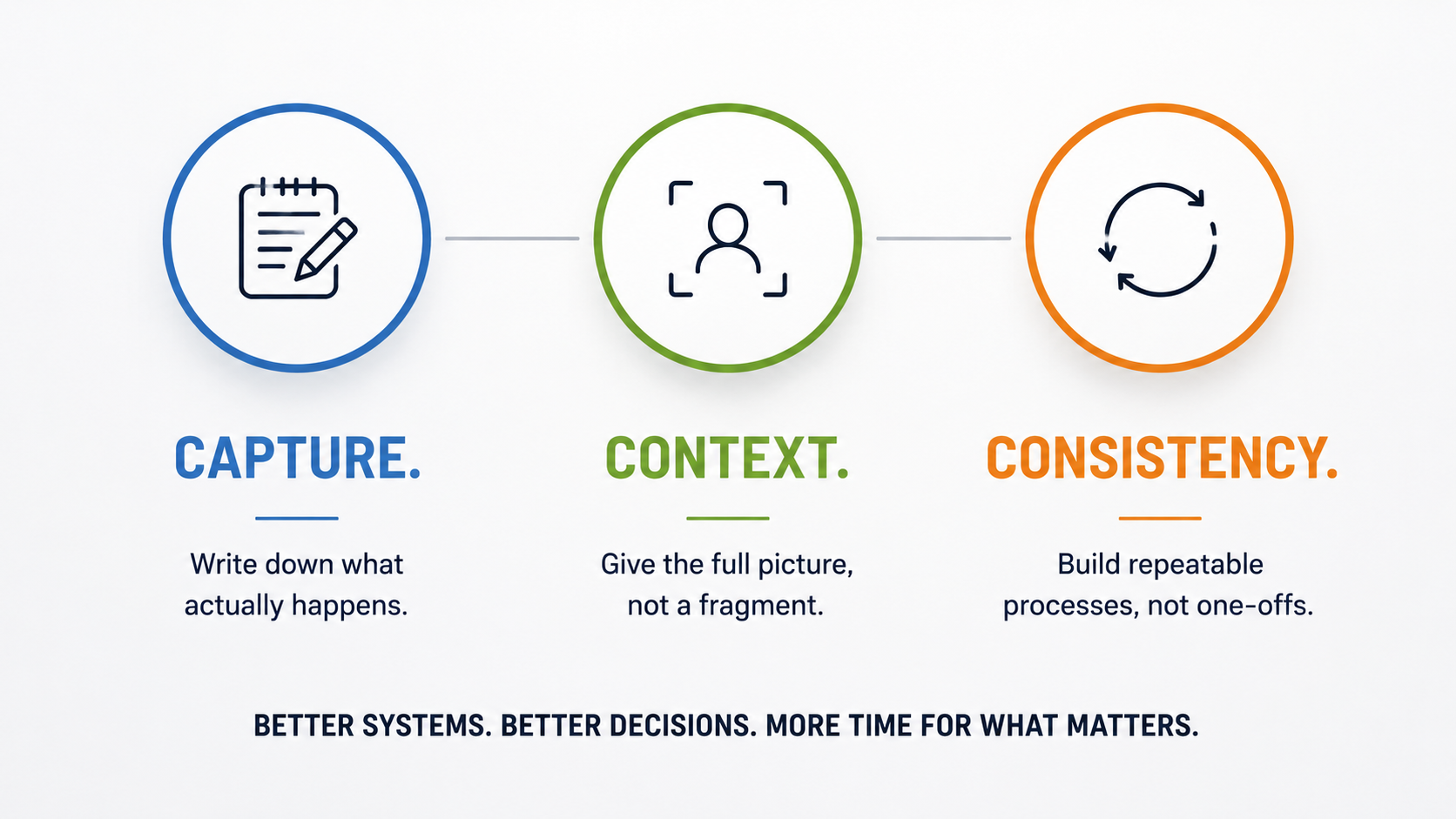
The useful framework he offered was simple: capture, context, consistency.
Those three things matter more than chasing the newest tool.
Capture What Your Business Already Knows
Every company has a huge amount of useful information moving through it every day. The problem is that much of it disappears almost as quickly as it is created.
A client asks a question. Someone writes a thoughtful answer. The project wraps. The team talks about what went wrong and what they would change next time. A producer solves a difficult problem onsite. A salesperson figures out a better way to explain something.
Then everyone moves on.
A month later, someone answers the same client question again. Another team encounters the same production problem. Another proposal gets written from scratch. Another person tries to remember what happened on the last show.
AI cannot organize knowledge that was never captured in the first place.
Mark illustrated that problem during his workshop with a live discussion about postmortems. Most companies in the room acknowledged that they were not conducting them consistently. At the same time, many admitted they routinely answer the same questions from clients over and over again.
Those two problems are connected.
A postmortem should not just be a conversation about what went well and what went wrong. It is an opportunity to capture institutional knowledge. Why did the crew call change? What surprised us about the venue? What did the client misunderstand? What question kept coming up? What would we quote differently next time?
When that information is documented, it becomes useful beyond the people who happened to be in the room.
That is where AI starts becoming interesting.
Context Is What Makes AI Useful
Giving AI information is not the same as giving it context.
There is a big difference between asking a tool to “write a response to this client” and giving it the client history, the scope of the project, the company’s pricing philosophy, what has already been discussed, the relationship involved and the outcome you are trying to achieve.
Without context, AI fills in the gaps.
Sometimes it fills them reasonably well. Sometimes it produces something that sounds polished while being completely wrong for the situation.
That is one reason owners sometimes experiment with AI, get mediocre results and decide the technology is overhyped. The tool may not be the problem. The prompt may be asking it to work without enough information.
The better question becomes: What would a knowledgeable employee need to know before handling this?
If a new account manager walked into the office and you gave them one sentence of background, you would not expect a perfect response. You would explain the client, the history, the priorities, the constraints and probably a few things that had already gone wrong.
AI needs the same kind of context.
The companies that become good at using it will not necessarily be the ones with the most sophisticated software. They will be the ones that get better at organizing and supplying the information behind the task.
Consistency Turns Experiments Into Systems
The third piece is consistency.
Anyone can write a clever prompt once.
That is not a business process.
If one salesperson uses AI to help write proposals, another uses it occasionally for email and a third has their own collection of prompts saved somewhere on their laptop, the company may be using AI, but it has not operationalized anything.
The value starts to compound when the process becomes repeatable.
That could mean a standard way to capture post-show notes. It could mean feeding every completed project through the same debrief structure. It could mean developing a consistent process for turning frequently asked client questions into reusable knowledge. It could mean creating company-specific instructions for proposals, sales follow-up, project planning or internal training.
The point is not to automate everything.
The point is to stop solving the same problem from zero every time.
Capture creates the information. Context makes that information usable. Consistency turns it into a repeatable system.
Human Beings Over Human Doings
There was another part of Mark’s workshop that matters just as much as the technology.
He described the goal as focusing on human beings over human doings.
That distinction is easy to overlook.
The promise of AI is usually described in terms of productivity. Save an hour here. Automate a task there. Produce more with fewer people.
But if every hour AI saves is immediately filled with another hour of work, nothing fundamental has changed.
You are simply moving faster on the same treadmill.
The more valuable question is what you intend to do with the time you get back.
Spend more time developing employees. Have a better conversation with a client. Think about where the company is going. Go home earlier. Take a vacation without checking your phone every twenty minutes.
Those outcomes require intention.
Mark shared his own experience from another business he operates, a small liquor store, as an example. From the stage, he reported that his AI-supported systems had saved roughly 207 hours since January and that the store was currently operating for about 9.7 hours each week without his direct involvement.
Those figures were self-reported from his own business, not the result of a controlled study, and a liquor store obviously operates very differently from an event production company. The important part of the example was not the exact number of hours.
It was what those hours represented.
His goal was not simply to squeeze more work into the day. It was to reduce the amount of routine activity that required his personal attention.
For owners of production companies, that may be one of the most useful ways to think about AI.
Not, How much more can I get done?
Instead, What no longer needs me?
Start With the Business Before You Start With the Tool
There will always be another AI platform to evaluate.
That makes it tempting to treat adoption like a software-shopping exercise. But buying another tool will not fix undocumented processes, scattered knowledge or inconsistent habits.
Before worrying about which AI platform your company should standardize on, take inventory of what is already happening inside the business.
Where are people answering the same questions repeatedly?
Where does useful information disappear after a project?
Which decisions depend entirely on one person’s memory?
Which processes change depending on who happens to be doing them?
Which recurring tasks still require an owner because nobody has documented how they actually work?
Those are the places to start.
The companies that get the most from AI will probably not be the ones that use the most AI.
They will be the ones that become better at capturing what they know, giving technology enough context to use it and building consistent processes around the things that work.
The tool comes after that.
Want more practical ideas for building a stronger production company? Subscribe to the Jumpstart newsletter for strategies drawn from the conversations and working sessions happening inside the industry. A self-audit worksheet based on the three-part framework is also coming soon.
Based on Mark Wells’ AI workshops at Jumpstart Vegas, July 2026.