At Jumpstart Las Vegas this July, Shane, VP of Technology at LMG, opened his session by asking a room full of live event company owners a simple question: how many of you feel completely caught up with technology? A single hand went up, out of a room made up entirely of people who buy, rent, and operate this gear for a living, which tells you the problem most of us are trying to solve is not actually a knowledge gap, it is a pace problem, and the argument on stage was that most of us have been pointing our effort at the wrong target.
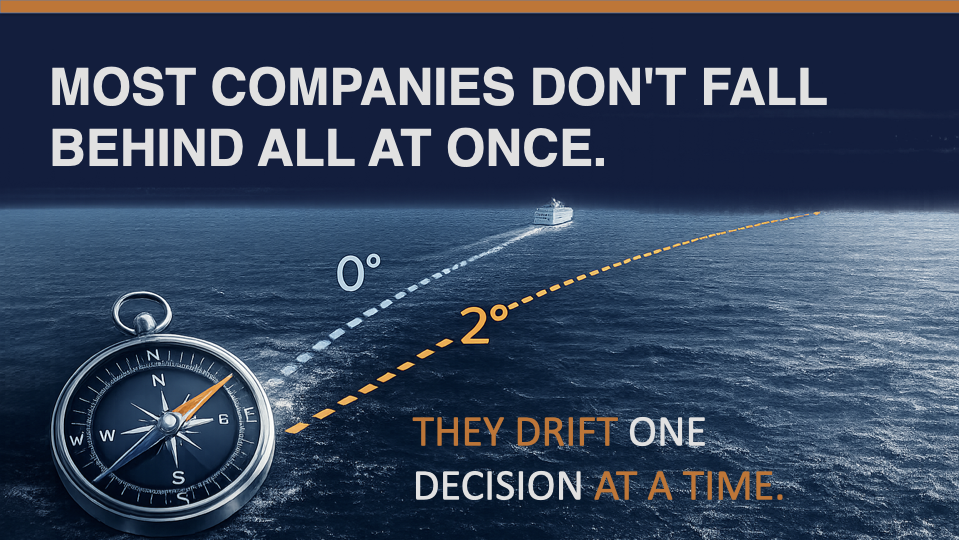
The talk was framed around a ship metaphor that is worth sitting with even if you were nowhere near that stage. A boat that is two degrees off course does not look off course after ten miles, but after a thousand miles it has arrived somewhere entirely different than intended, and technology decisions inside a live event company tend to work the same way. Companies rarely wake up one morning and discover they have fallen behind all at once. It happens through a long accumulation of small, individually reasonable choices to wait, to see what happens next quarter, to let someone else make the first move on a new format or tool, and none of those choices feel like a mistake in the moment, which is exactly why the drift goes unnoticed until it has become the whole story of the company.
The part worth sitting with is that the point being made was never that we all need to keep up faster. Keeping up stopped being a realistic goal, because the window available to evaluate any new piece of technology has collapsed to almost nothing. The example used on stage was Source Intelligence, the L Acoustics product that shipped this past May and uses machine learning to isolate a human voice out of a live mic signal, filtering out everything else in the room. Within a month of that product launching, someone else was already writing comparable software on their own, which illustrates how much the timeline has compressed industry wide. What used to take years to properly evaluate started taking months a while back, and now it often takes weeks or even days, and none of the usual responses actually solve that problem. More trade shows, another newsletter subscription, one more certification, none of it changes the fact that the number of hours available in a given day has stayed exactly the same while everything competing for those hours has multiplied.
The alternative that was offered on stage was a filter built out of three layers that work together rather than in isolation. Knowledge is the layer that tells you what is possible, the pile of notes anyone brings home from a show floor, and it matters, but on its own it is close to useless because it never tells you what action to actually take. Discernment is the layer that does real work, and it has nothing to do with whether something looks impressive. It comes down to asking whether a given technology solves a problem you genuinely have, whether it is mature enough to hold up in a live event environment (or whether the live event industry itself is even ready to use it well), and whether the timing actually makes sense for your business right now rather than in some hypothetical future. Wisdom is the layer that turns discernment into a decision you are willing to act on, and one of the more honest admissions from the stage was that almost none of the best technology decisions referenced there were made by one person working alone.
That last point is worth building an actual planning conversation around inside your own company. The argument was that this industry does not need more vendors, it needs more strategic technology partners, and the distinction drawn between the two was sharper than it might sound at first. A vendor answers the questions you already know to ask. A partner asks you better questions than the ones you started with, and just as often tells you what not to buy rather than pushing another purchase. That distinction mattered less when technology only turned over every five or ten years, because getting three quotes and picking one was a perfectly reasonable way to make a decision. It matters enormously now, because the person offering the lowest price is no longer the most valuable person in the room. The person with the best judgment is, and that judgment is rarely something one person develops in isolation.
So regardless of whether you were in that room in Las Vegas, the useful exercise is the same one that talk was pointing toward. Sit down and name who actually shaped your last three meaningful technology decisions. If the honest answer is nobody but yourself, or nobody but a sales rep trying to close a quota, that is where your company’s drift is quietly happening. It was never really about the gear you did or did not buy. It has always been about whether you built a room of people whose judgment you trust enough to make that decision alongside you.