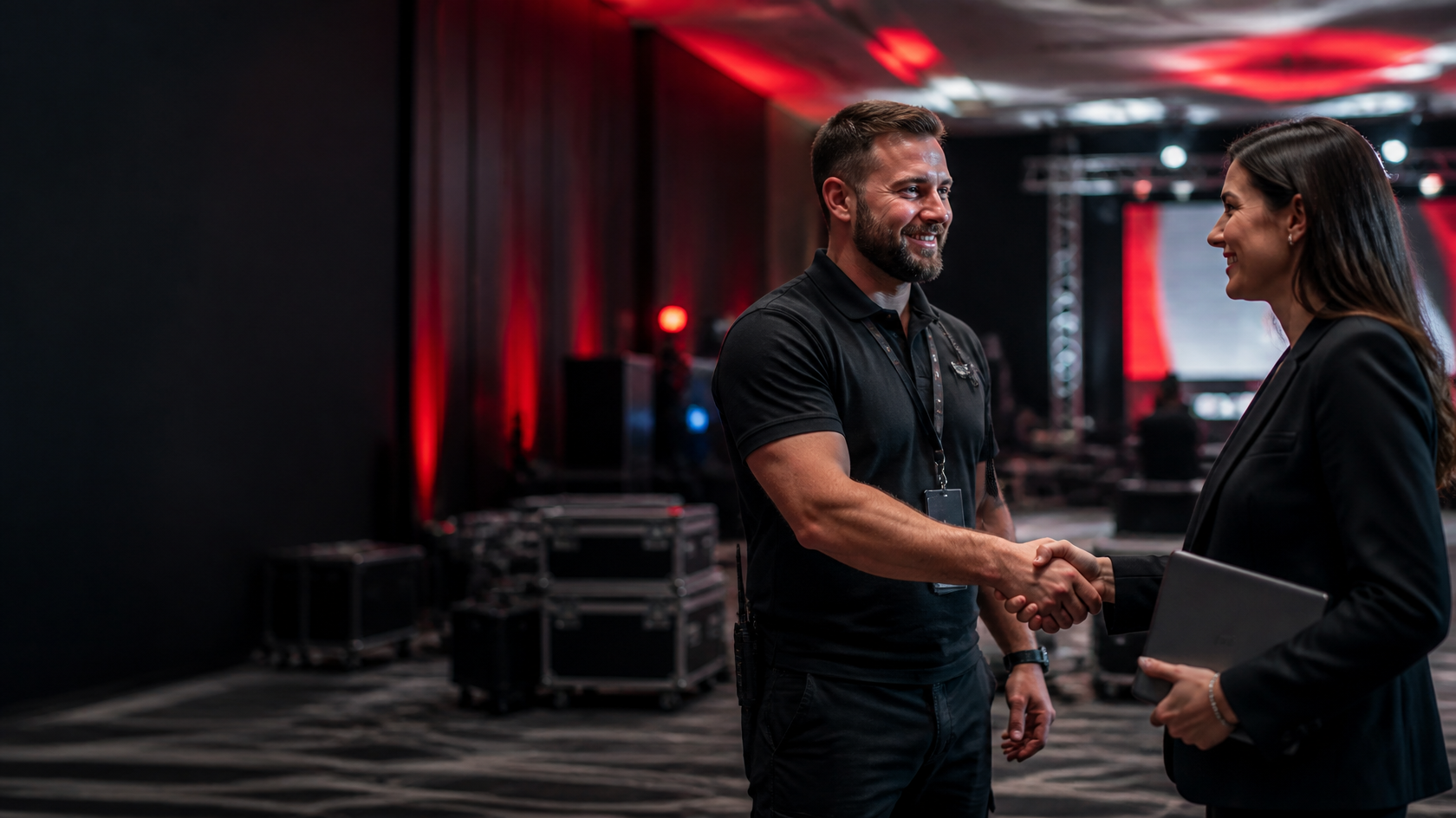
Spend a few minutes scrolling through the websites and social media pages of AV production companies, and you’ll start noticing some similarities. There are photos of LED walls, lighting rigs, impressive stages, neatly arranged equipment racks and trucks being loaded for the next event. The captions often describe the technology, the size of the setup or the capabilities of the company that provided it.
There’s nothing inherently wrong with showing off your equipment or the work your team has accomplished. Production professionals appreciate good technology, and a well-executed event deserves recognition. The question is whether those images and descriptions are doing much to convince a potential client to hire you.
If your marketing is intended to attract event planners, corporate meeting professionals, associations or other organizations that purchase production services, it’s worth considering how those audiences evaluate what they’re seeing. The things that impress another AV professional aren’t necessarily the things that influence a client’s buying decision.
Who Are You Actually Marketing To?
Our industry spends a considerable amount of time talking to itself. We follow equipment manufacturers, share photos of new technology, discuss technical specifications and celebrate impressive production designs. Those conversations are valuable within the industry, particularly when we’re evaluating new investments, recruiting technical talent or developing relationships with other production companies.
But a marketing message that resonates with an industry peer may not mean much to the person responsible for selecting a production partner.
Consider a social media post highlighting a large LED wall installation. Other AV professionals might notice the pixel pitch, processing equipment, rigging configuration or overall execution. A meeting planner might appreciate that the stage looks impressive, but they’re probably thinking about something different. They want to know whether the screen will support their presentations, whether the audience can see the content clearly and whether the production team can adapt when the program changes.
Both audiences are looking at the same image, but they’re evaluating different things.
If your goal is to attract more clients, your marketing needs to speak to the people making purchasing decisions rather than primarily to the people who understand the equipment.
Capabilities Are Not the Same as Differentiation
Most established production companies can provide microphones, lighting, video displays, staging and technical crews. The equipment may vary, and some companies have more extensive inventories than others, but the fundamental capabilities are often similar.
That creates a challenge when every company describes itself using essentially the same language.
Visit enough AV company websites and you’ll encounter familiar claims about state-of-the-art technology, experienced technicians, exceptional service and unforgettable events. These statements may be accurate, but they don’t give a prospective client much information about what makes one company different from another.
A company that owns a substantial inventory of LED panels may have a competitive advantage in certain markets. Another company may have developed an exceptional process for managing complex, multi-room conferences. A third might specialize in helping corporate communications teams produce executive presentations.
Each company has something potentially valuable to communicate, but those advantages require more explanation than a list of services or a photograph of equipment.
Differentiation becomes meaningful when a prospective client can recognize why your particular strengths matter to their event.
Show the Decisions Behind the Production
One of the most useful ways to improve AV marketing is to explain the thinking behind the work.
Instead of simply posting a photograph of a general session, describe a challenge the team needed to solve. Perhaps the room had limited ceiling height, the event required unusually fast transitions or the production schedule allowed very little time between rehearsals and doors opening.
Explain how your team approached the situation, what decisions were made and why those decisions mattered.
You don’t need to reveal confidential client information or turn every project into a lengthy case study. A few thoughtful sentences can provide enough context to demonstrate the experience behind the finished production.
For example, a post about an awards program could explain how the production team coordinated presenter movements, playback, lighting cues and stage transitions to maintain the pace of the show. That tells a prospective client something about your ability to manage a complicated live program.
A photograph of the stage alone doesn’t communicate nearly as much.
The goal isn’t to make every post educational. It’s to give potential clients evidence that your company understands the challenges they’re responsible for managing.
Your People Are Part of What You’re Selling
Equipment is relatively easy to photograph. The work of an experienced producer, project manager or technical director is much harder to capture, even though those individuals may be among the most important reasons a client chooses to work with your company.
Think about the value of a project manager who identifies scheduling conflicts before they become problems, an audio engineer who understands how to support a nervous executive presenter or a technical director who can coordinate multiple departments during a complicated show.
Those capabilities affect the client’s experience in ways that equipment specifications rarely communicate.
Yet many AV companies devote more marketing attention to their latest equipment purchase than to the expertise of the people responsible for delivering their events.
There are opportunities to change that without resorting to generic employee spotlights or lengthy biographies. Share examples of how your team approaches production planning, prepares for rehearsals, coordinates with venues or manages unexpected changes.
Explain the responsibilities your people take on and the decisions they’re trusted to make.
Prospective clients need confidence that the team supporting their event will understand their priorities, communicate effectively and take responsibility for the work. Your marketing can help establish that confidence long before the first sales conversation.
Don’t Confuse Activity With Effective Marketing
Another challenge for production companies is the pressure to maintain a constant presence on social media. Marketing calendars get filled with equipment photos, event recaps, holiday graphics and announcements because there’s an expectation that the company should be posting regularly.
Consistency matters, but the number of posts published doesn’t tell you whether your marketing is attracting the right audience.
A photograph of a new lighting fixture may generate engagement from technicians and equipment manufacturers. That’s useful if you’re trying to build industry relationships, but it may contribute very little to your goal of securing additional corporate events.
A post discussing how your team handles last-minute executive presentation changes might receive fewer reactions while being considerably more relevant to the people who hire production companies.
This doesn’t mean engagement is irrelevant. It means engagement needs to be evaluated in the context of the audience you’re trying to reach.
If your business development strategy depends on relationships with event planners, association executives or corporate meeting teams, your marketing should create opportunities for those people to recognize your expertise and begin conversations.
That requires understanding who is responding to your content, not simply counting how many people responded.
Build Your Marketing Around the Problems You Solve
A useful exercise is to review your last ten marketing posts and identify what each one communicates to a potential client.
Does the post demonstrate a capability, explain a production decision, address a client concern or provide evidence of how your company works? Or does it primarily announce that your team completed another event?
There’s room for both, but if nearly everything you publish falls into the second category, your marketing may be missing opportunities to build a stronger position in the market.
Start by identifying the questions and concerns that come up repeatedly during sales conversations. Perhaps clients struggle with understanding production budgets, coordinating multiple vendors, preparing executives for presentations or determining what technical support their events actually require.
Those conversations can become valuable marketing content because they’re already connected to problems your prospective clients are trying to solve.
You can also look at the projects your company handles particularly well. What makes those events successful? What does your team do differently? What expertise would a potential client need to understand before recognizing the value of working with you?
The answers can help you develop marketing that reflects your company’s actual strengths rather than relying on the same general claims used throughout the industry.
Give Clients a Reason to Remember Your Company
The AV industry will always be driven in part by technology. Equipment investments matter, technical innovation creates opportunities and impressive production environments are worth sharing.
But technology alone rarely explains the entire value of a production partner.
The companies that stand out are often the ones that help clients understand what they’re getting beyond the equipment: experienced judgment, thoughtful planning, reliable communication and a team that takes responsibility for delivering the event.
Your marketing should make those qualities visible.
The next time you’re preparing to post a photograph of a stage, a lighting rig or a truck full of equipment, consider what else the image could communicate. Think about the decisions, planning and expertise that made the production possible, and whether those details would matter to someone considering hiring your company.
You don’t have to stop showing your equipment. You just need to make sure you’re showing clients why your company is worth hiring.
Take a Closer Look at Your Business at Jumpstart Orlando
Marketing is only one part of building a successful AV production company. Positioning, sales, operations, leadership and client relationships all influence whether a business can grow sustainably.
At Jumpstart Workshops, November 16–18 in Orlando, AV company owners and senior leaders will spend two and a half days working on the business decisions that affect their companies’ performance and future growth.
Join us in Orlando and take advantage of the current $300 registration savings with the code 300OFF.