Every AV conversation this year has the same shape. Someone brings up InfoComm 2026, mentions “agentic AI,” and the room nods like that settles it. Self-optimizing systems that flag equipment failures before they become showstoppers. Cameras that track a speaker without an operator. Captioning and translation that happen in real time. All real, all useful, none of it is where the money is for you.
Here’s the miss: production company owners are evaluating AI the way they evaluate gear, as something that goes on the show floor. That’s the wrong place to look. The actual leverage is in the parts of your business nobody puts in a case study, the scheduling, the proposals, the vendor coordination, the fifty small admin tasks that quietly determine whether you can take on a fourth show in a week without hiring another full-time coordinator.
The labor story is being told about the wrong people
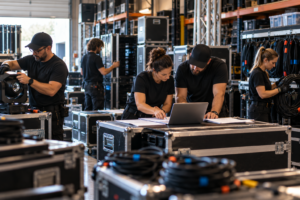
Jeff Bezos said this month that AI is going to create labor scarcity, five months after Amazon cut 16,000 jobs and cited AI as the reason. That contradiction isn’t noise, it’s the actual shape of what’s happening. AI is displacing coordination and administrative work at scale while doing very little to skilled, physical, judgment-heavy labor. Riggers, audio techs, LDs, the people on your freelance bench, none of that work is going anywhere. What’s exposed is the layer above them: the person whose whole job is tracking who’s confirmed, chasing paperwork, and reconciling three spreadsheets before a show.
If your operating model already keeps overhead lean and pushes show labor to a freelance bench instead of a bloated core staff, this trend doesn’t threaten you. It’s a tailwind. Every competitor who built a heavier office layer to manage logistics manually is now carrying cost structure that AI just made optional. You don’t need to convert freelancers to core staff to solve for scale. You need the admin layer to get thinner, not the crew layer.
Your clients are about to stop needing you for the easy part
The second thing nobody’s saying out loud: the AI tools showing up in event planning software aren’t built for you, they’re built for your clients. Vendor-matching engines that pair planners with production companies based on geography and specs. Attendance and budget forecasting that used to require your experience to eyeball. Writing assistants that draft the RFP language a coordinator used to bill hours for. None of this replaces production. All of it chips away at the coordination and sourcing work that a lot of companies have quietly folded into their fee for years.
That’s the actual risk, not that AI takes your show, but that it commoditizes the parts of your service that were never really about production expertise in the first place. If a meaningful chunk of your value proposition is “we’ll handle the logistics and paperwork so the client doesn’t have to,” that proposition gets weaker every quarter these tools improve. The fix isn’t panic, it’s clarity about what you’re actually charging for. Judgment under pressure, relationship equity with a freelance bench that shows up when you need them, the ability to catch the failure nobody saw coming, none of that is available off the shelf. Lean into billing for that, explicitly, and stop pricing as if the admin work were the hard part.
Where to actually spend your attention
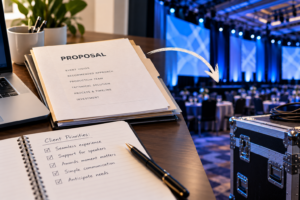
IBC’s number, roughly 70 percent of production companies planning to integrate AI tools into workflows by 2027, tells you the window for this being a differentiator is closing fast. The owners who get value out of this in the next twelve months aren’t the ones chasing the flashiest InfoComm demo. They’re the ones running AI through the boring stuff first: proposal drafting, scheduling logic across a bench of freelancers, vendor communication, post-show reconciliation. That’s where hours get returned to you, and hours returned to an owner running lean are hours that go straight to sourcing the next client relationship or deepening the one you already have.
The consultant’s version of this advice is unglamorous but it’s the right one. Don’t ask what AI can do for your show. Ask what it can take off your desk so you spend more time on the two things that were never going to be automated: the relationships that keep your freelance bench loyal, and the judgment that keeps a show from becoming a disaster the client remembers for years.