Published 3/18/26
How Mastering AI Turns AV Stress into Creative Dominance
Jensen Huang, the CEO of Nvidia and arguably the most influential voice in tech right now, did not mince words: mastering AI prompting is a superpower. His audience was Silicon Valley, but his message belongs to every AV company owner staring down a 72-hour load-in, a last-minute client revision, and a crew that is one person short.
This is not abstract advice about the future of technology. It is a direct blueprint for how live event production companies can multiply their output, reduce the chaos that eats margins, and turn AI from an industry buzzword into a crew member that never sleeps, never calls in sick, and never misses a cue.
The question is not whether AI is coming to AV. It is already here. The question is whether you are going to drive it or be passed by it.
The gap between early adopters and everyone else is widening fast. Those who wait risk becoming the legacy provider clients quietly bypass.
Your Crew Has Always Run on Split-Second Decisions
Live production has always rewarded people who think fast under pressure: reading a room full of 2,000 attendees, adjusting stage wash when the speaker moves out of key light, cutting to a reaction shot on instinct, or troubleshooting a ground loop in front of a C-suite audience with no time to spare.
That skill is not going away. In fact, it is becoming more valuable. As AI absorbs the repetitive, data-heavy, and administratively exhausting work that drains your best people, your technical instincts and client relationships become the differentiator that no model can replicate.
AI cannot feel crowd energy. It cannot improvise a human moment. But when you prompt it expertly, it handles the parts of your business that slow you down, at speed and precision that no human team can match alone.
Pre-Production: From Concept to Client-Ready in Hours
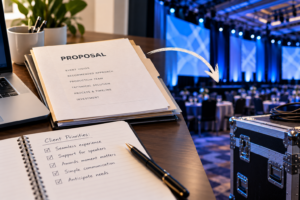
Think about how much time your team spends before a single cable gets pulled. Stage concepts, mood boards, lighting plots, motion graphic directions, branded visuals, experiential ideas, equipment schedules, run-of-show drafts. That work used to take days. With the right prompts and the right tools, it takes hours.
AV owners using generative AI tools are now able to prototype ten concepts where they previously showed clients two. They walk into bid presentations with richer options, faster. Designers stop burning out on early-round iterations and save their creative energy for the decisions that require human taste.
The result is higher win rates, happier clients before the event even starts, and a proposal process that feels like a competitive advantage rather than a grind.
TRY THIS THIS WEEK
Write this prompt: “Generate 10 stage design concepts for a 500-person corporate product launch. The brand palette is navy, gold, and white. The client wants energy and innovation, not traditional boardroom staging. Include notes on lighting approach and set geometry for each.” Run it in ChatGPT, Claude, and one other model. Compare the outputs. You will not run out of ideas again.
Showtime: Smaller Crews, Higher Production Value
The live show environment is where AI integration gets genuinely exciting for technical directors. Several of the advances that felt like distant future tech are now available and being deployed at real events:
Camera auto-tracking and intelligent switching: Some AI-driven camera systems now react to speaker changes in approximately 20 milliseconds, faster than most experienced human operators. Smaller crews can cover larger stages with consistent results.
Adaptive audio mixing: AI tools can analyze room acoustics in real time and make micro-adjustments that would take a skilled engineer years to internalize.
Lighting that responds to movement: Systems that read presenter position, adjust key light automatically, and shift color temperature based on content transitions are moving from broadcast studios to live event floors.
Predictive equipment monitoring: AI-driven diagnostics can flag potential failures before they become show-stopping problems, giving your crew time to swap gear rather than scramble.
On-the-fly content generation: Session summaries, real-time translated captions for hybrid audiences, adaptive display content that shifts with the agenda.
A three-person crew operating AI-assisted systems can now punch above what a five-person crew delivered three years ago. That is not a threat to your team. That is a margin improvement.
Post-Event: Turn One Gig into Months of Value
The event ends. The trucks get loaded. In most AV shops, so does the revenue potential of that event. The footage goes to a hard drive. The client gets a highlight reel if you are lucky. The opportunity is largely over.
AI changes that math entirely. Raw footage can now be processed almost immediately into personalized attendee recaps, social media clips optimized for LinkedIn and Instagram, marketing assets for the client, training content for internal audiences, and speaker highlight packages. One event fuels a content engine that runs for months.
For AV companies, this opens a conversation with clients that did not exist before: post-production as a recurring revenue line, not a one-time afterthought. The shops that figure this out first will have stickier client relationships and a stronger case for retainer arrangements.
One event now fuels months of value instead of gathering dust. That is the difference between a transaction and a revenue stream.
The Authenticity Premium: Why AI Makes Live Events More Valuable
There is a counterintuitive truth in this moment: as AI-generated content floods the internet and synthetic experiences multiply, live events are becoming the premium antidote. Real human energy. Real imperfection. Real connection in a room.
Clients are beginning to feel this. They are paying more for experiences that feel genuine, that cannot be faked, that require bodies in a room and a crew that knows what they are doing. The brands that understand this are doubling down on live rather than retreating to virtual.
Here is what that means for your business: AI tools deployed by skilled AV companies do not dilute the authenticity of live events. They amplify it. Better visuals create more immersion. Smoother technical execution keeps the audience focused on the content and the moment, not the gear. Fewer technical problems mean the human energy in the room can breathe.
Your job is not to compete with AI. Your job is to use AI to make the human moments in every show hit harder.
The Prompting Skill Gap Is Real and Growing Fast
Over 70 percent of event technology companies are already building or integrating AI features into their workflows. That number will be higher by the time you finish reading this article.
The AV owners and technical directors who are moving fastest are not necessarily the ones with the biggest budgets or the most advanced gear. They are the ones who have committed to learning prompting as a genuine craft, the same way they learned to design a lighting rig or operate a digital console.
Prompting is a skill. It rewards specificity, iteration, and curiosity. A vague prompt gets a vague output. A precise, well-structured prompt with clear context gets something you can actually use. The gap between those two is exactly the gap between the AV shops that will lead the next five years and the ones that will be explaining to clients why they cost more than the competitor who just showed up with a smarter workflow.
WHERE TO START
Pick one pain point in your current workflow, pre-production proposals, post-event content, or crew scheduling, and spend 30 minutes prompting against it this week. Compare outputs across at least two models. ChatGPT, Claude, and Grok each have strengths. For visuals, experiment with Midjourney or Flux. For motion content, Runway and Sora-style tools are maturing fast. Practice daily and iterate ruthlessly.
Go Deeper: AI Without the Overwhelm at Jumpstart Workshops
If the ideas in this article are resonating but the implementation feels uncertain, you are not alone. Most AV company owners did not get into this business to become AI researchers. You got into it because you love the craft, the production, and the energy of live events.
That is exactly why Jumpstart Workshops brought in Mark Wells to lead a session built specifically for this moment.
“Practical AI for Your Operation”** with Mark Wells**
Mark’s session is designed for AV and live event production company owners who want a practical, non-technical path into AI adoption: which tools are actually useful, how to prompt them for real production scenarios, and how to build habits that stick without derailing your existing workflow. No hype. No jargon. Just actionable strategy for the business you are already running.
Jumpstart Workshops | May 4-6, 2025 | [Aloft Lake Nona Hotel,]() Orlando, FL
Register and learn more at [jumpstartworkshops.com]()
Start This Week, Not Next Quarter
The instruction here is simple. Do not wait until you feel ready, because the industry is not going to wait for you. Pick one prompt. Run it against one problem in your business. Compare it across two or three models. See what comes back. Then do it again tomorrow.
The AV companies that will own the next decade are the ones whose teams treat AI like a core production skill, not an IT initiative. The ones who approach prompting the way they approached learning a new lighting console or mastering a new audio platform: with practice, with curiosity, and with the competitive drive that got them into this business in the first place.
The tool is already on your phone. The question is what you are going to build with it.
*Jumpstart Workshops is a business education series built for AV and live event production company owners. Learn more at jumpstartworkshops.com.